

For 2,000 years, China called these dragon teeth.两千年来,中国人叫它龙齿。
Giant teeth in medicine drawers, a monk's note about a kitchen pillar, and a man who said only “I am awake”. What each old story means if you are walking into 2027.
By The Bone Moon Journal · 8 min read
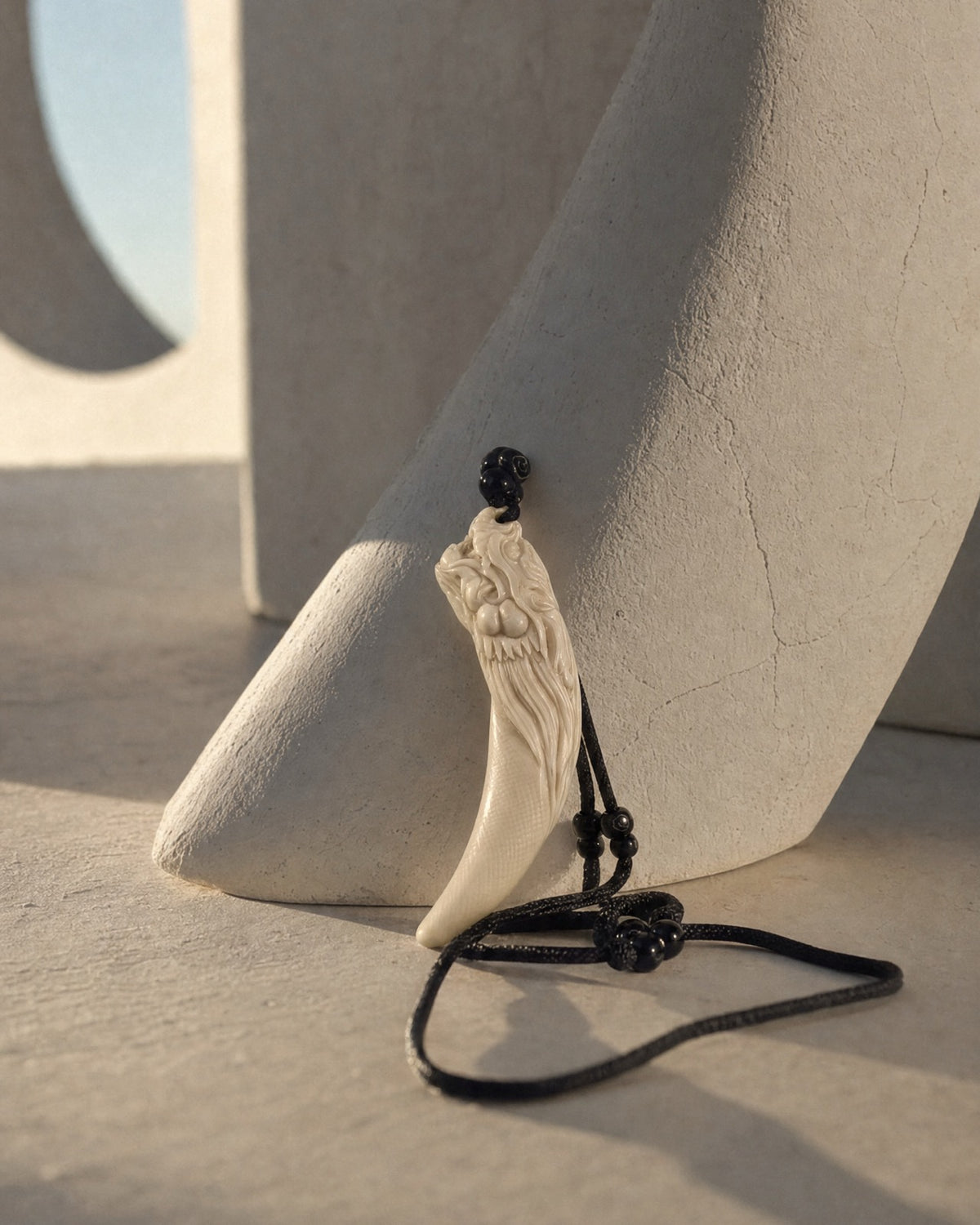
For most of recorded Chinese history, if you walked into a traditional medicine hall and asked for 龍齒, dragon teeth, the shopkeeper would open a drawer and hand you one.
They were real teeth. Huge, heavy, dug out of riverbanks and hillsides. They simply did not belong to dragons.
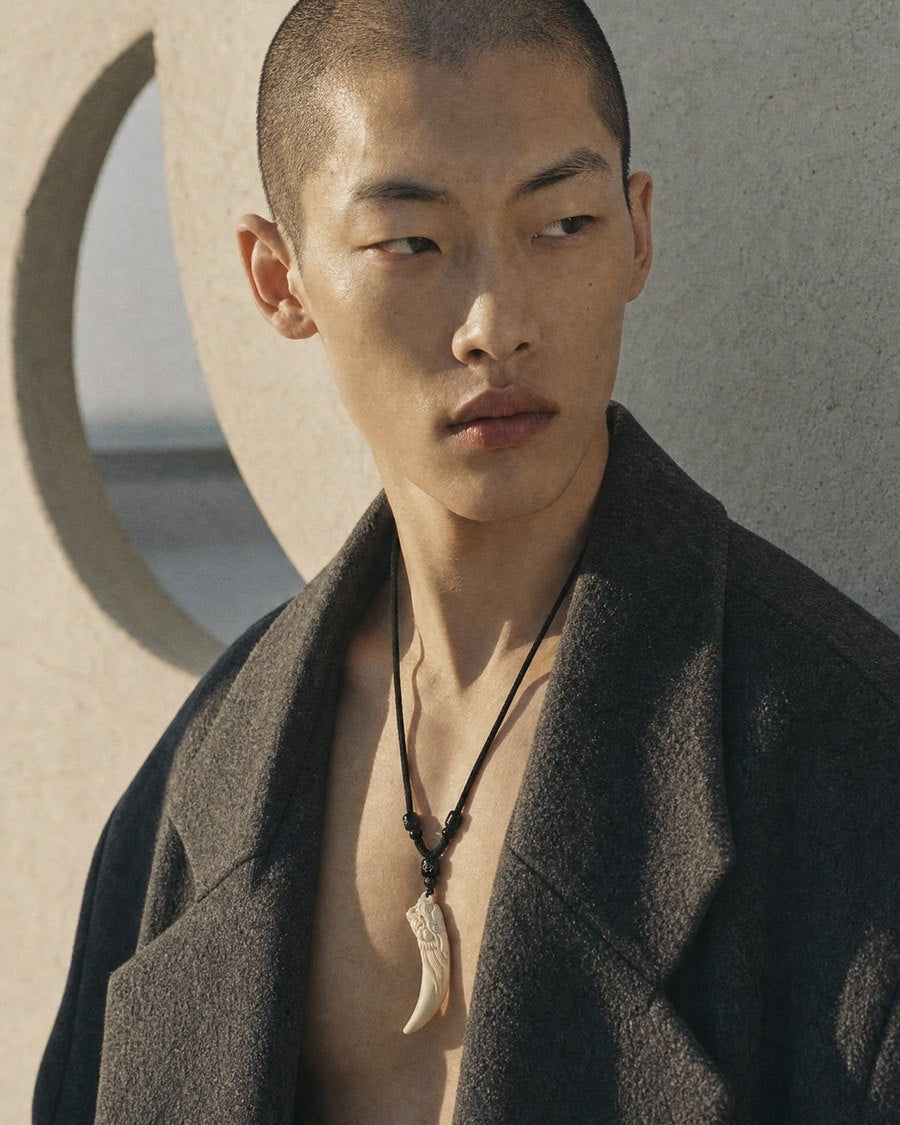
This is the story of where those teeth came from, why we carve ours from mammoth tusk, and the three older stories, a dragon, a guardian and an awakened man, that each piece carries.
I. The dragon teeth in the medicine drawer一、药柜里的龙齿
Han-dynasty herbal texts, roughly two thousand years old, already list 龍骨, dragon bone, with dragon teeth alongside. In 1578 Li Shizhen's 本草纲目 still described them. For centuries they were ground and prescribed.
Most of what was sold, we now know, was fossil: the teeth and bones of ancient mammals, including extinct elephants and their relatives, washed out of the earth.
The drawers held more than medicine. In the most-told version of the story, in 1899 the scholar Wang Yirong noticed carving on “dragon bones” bought for his illness, and recognised the earliest Chinese writing, the oracle bones. Historians debate the details. The discovery is real.
And in 1935 a palaeontologist named Ralph von Koenigswald, browsing a Hong Kong medicine shop, bought a giant molar labelled dragon tooth. It became the first known fossil of Gigantopithecus, the largest ape that ever lived.
What it means for you today. In Chinese legend, nobody is born a dragon. 鲤鱼跃龙门: the carp that leaps the Dragon Gate becomes one. The dragon's tooth is the leaper's trophy. For anyone chasing a number in 2027, it is a reminder to go and get it, not wait to be handed it.
II. Why mammoth tusk二、为什么是猛犸牙
Woolly mammoths roamed the cold north for hundreds of thousands of years. The last of them died out about four thousand years ago, on a remote Arctic island.
Their tusks lay frozen in the Siberian permafrost. As it thaws, tusks surface along riverbanks and are recovered. No living animal is involved.
That gives the material three qualities we care about. It is genuinely ancient. It is pale, dense and fine enough to carve in close detail. And no two tusks share the same grain, colour or mineral marks, so no two pieces are alike.
| Mammoth tusk | |
|---|---|
| Source | Siberian permafrost |
| Animal | Woolly mammoth, extinct for thousands of years |
| Legal status | Mammoth is not a CITES-listed species; our material is legally sourced |
| Character | Natural growth lines and mineral tone, unique to each piece |
It also closes a loop. The dragon teeth in those old drawers were often the teeth of the mammoth's cousins. Ours come from the same family of giants, finally carved into the dragon they were always called.
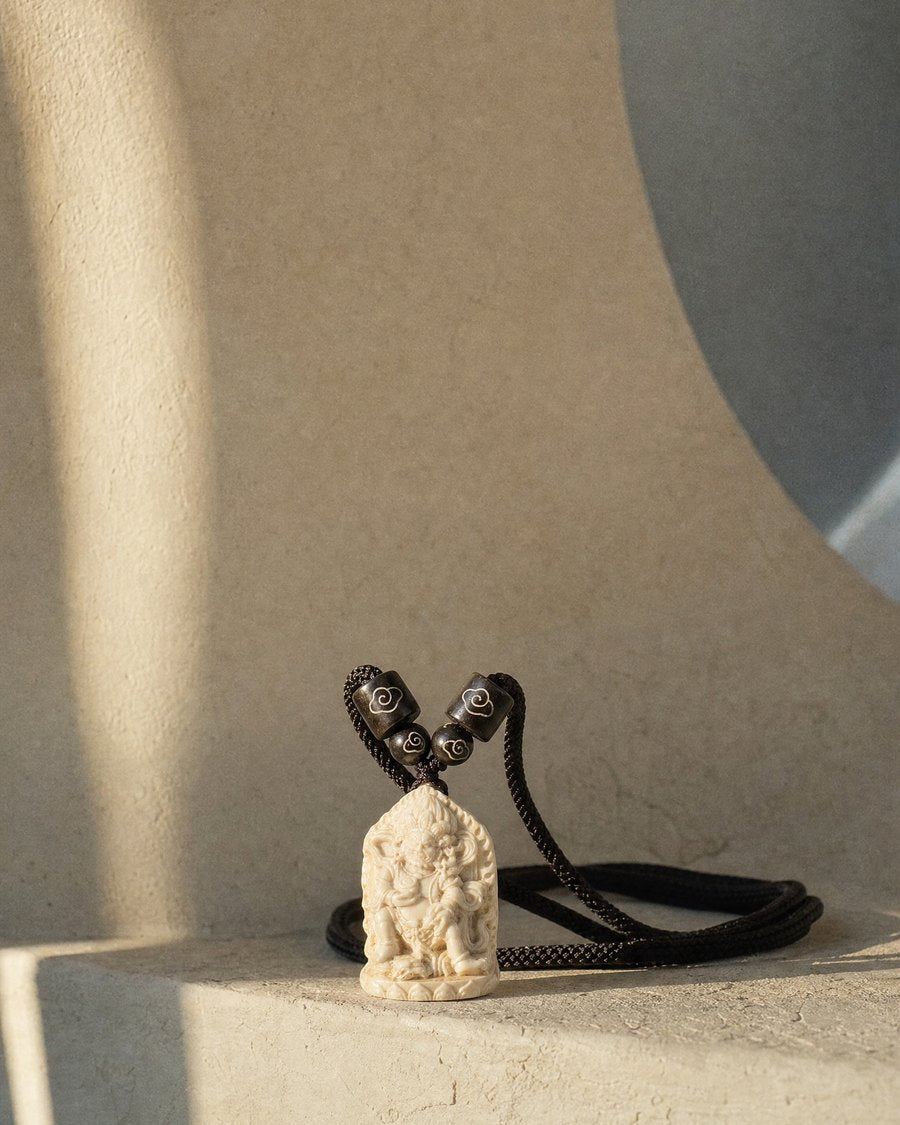
III. The monk, the kitchen pillar and the rice三、厨柱旁的大黑天
In 671 the monk Yijing, 义净, sailed from Guangzhou toward India. He stopped for months in Srivijaya on Sumatra, studied for about a decade at the great monastery of Nalanda, and later wrote his account back in Srivijaya, a short sail from where Singapore sits today.
In it he describes something he saw in Indian monasteries: an image of a dark deity, 大黑神, Mahakala, kept by the kitchen pillar or at the storeroom door. Each day food was offered to him. Monks believed he kept the stores full so the community never went without.
That is around 1,300 years of one idea: someone stands by the rice. In Japan the same figure later became Daikokuten, a god of wealth, often shown on bales of rice.
In Tibetan tradition Mahakala is regarded as a wrathful form of Avalokiteshvara, the bodhisattva Chinese households know as Guanyin. An old saying puts it well: 菩萨低眉,金刚怒目. Bodhisattvas lower their eyes; guardians glare. Same compassion, different speed. Wrathful protectors are traditionally believed to act fast.
What it means for you today. Your rice bowl, 饭碗, is your income: the job, the shop, the commissions a family leans on. In a year of cuts and slow months, he is a symbol of guarding what you have already built, and a reminder not to let it leak away.
IV. “I am awake”四、佛,就是醒着的人
In an early Buddhist text, the Dona Sutta, a man sees the Buddha on the road and is struck by him. Are you a god, he asks. A spirit? A man? The answer to each is no.
Remember me as one who is awake.
The Buddha, Dona Sutta, AN 4.36 (paraphrased translation)
That is all the word means. Buddha, 佛, the awakened one: someone who sees things as they are.
In another teaching, the Kalama Sutta, he told the Kalama people not to accept a thing because of rumour, tradition, scripture or a teacher's authority. Test it, and see for yourself. That included his own words.
And there is the old parable of the blind men and the elephant. One touches the tusk, one the leg, one the tail, and each is sure he knows the whole animal. Only someone who sees the whole elephant knows what it is. Our Buddha happens to be carved from the tusk of the elephant's ancient cousin.
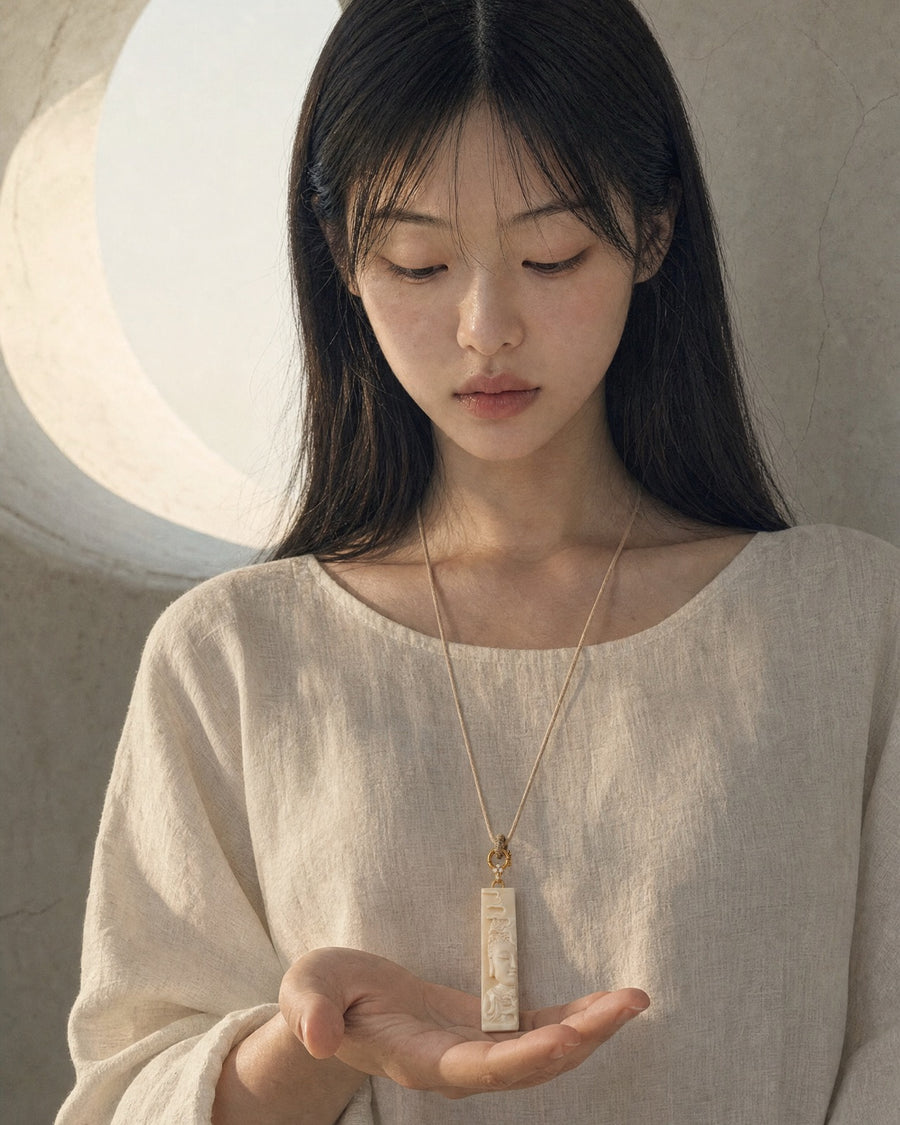
What it means for you today. The blind men each trusted the part they could touch. Today it is a partner with a promise, an investment with a story, a contract with small print. The face rising where the clouds part, 拨云见日, is a reminder to look twice before you sign, invest or trust.
V. Why 月牙, Bone Moon五、月牙之名
In Chinese, the crescent moon is 月牙. 牙 is tooth. A crescent is, quite literally, the moon's tooth.
A mammoth tusk is a pale crescent that grew out of the earth. So we named the collection after it, and gave the three pieces one line between them.
Win it. Keep it. See it coming. 争得到,守得住,看得清。
Most years ask for one of those more than the others. Some ask for all three.
VI. 包浆: the patina you earn六、包浆:戴出来的光
Chinese collectors have a word for the soft sheen that old jade, wood, bamboo and tusk take on after years of handling: 包浆. It cannot be bought new. It builds slowly from skin, touch and time.
Traditionally a good 包浆 is prized because it proves a thing was kept and lived with, not left in a drawer.
Worn daily, mammoth tusk is expected to begin warming toward its own tone over the months. How much depends on the piece and how you wear and care for it.
What it means for you today. Wear it into 2027 and by next Chinese New Year it should look a little different from the day it arrived. A quiet record that you kept it on, and kept your word to yourself.
VII. Why now: the Fire Goat year七、为何是现在:丁未火羊年
Chinese buyers get two new years. 1 January, then Chinese New Year on 6 February 2027, when the 丁未 Fire Goat year begins. It is the traditional moment to decide what you carry into the year.
Tradition also reads each year against your zodiac sign through 太岁, the year's ruling star. This is folk belief, not prediction, but many families still check it before the new year.
| Your sign | Traditional reading for 2027 |
|---|---|
| Goat 羊 | 值太岁, your own year |
| Ox 牛 | 冲太岁, clash with the year |
| Rat 鼠 | 害太岁, harm |
| Dog 狗 | 破太岁, break |
| Rabbit 兔, Pig 猪 | 三合, in harmony with the year |
| Horse 马 | 六合, in harmony with the year |
Which one is yours?哪一件是你的?
Which one is yours哪一件属于你
Four questions, about 30 seconds. We read your birth chart and where your life is right now, then tell you which piece is yours, or which two.
四个问题,约三十秒。根据你的八字与人生阶段,告诉你哪一件属于你。
When were you born?你的生日
Used only to read your chart on this page. Nothing is stored.
Where is life right now?你现在的人生阶段
What do you do?你的工作
What's on your mind most?最近最在意的事
Choose up to two.
Win it. Keep it. See it coming.
Three old stories, one collection. Any two pieces are 18% off and all three are 28% off, applied automatically at checkout. Each piece is checked by hand before it ships, with a 30-day right-fit exchange, lifetime free servicing and an adjustable cord.


- Any 218% off
- All 328% off
S$964.00 S$694.08 for all three, applied at checkout
Checked by hand before it ships · 30-day right-fit exchange · Lifetime servicing
Were dragon teeth really mammoth teeth?
Many were fossil teeth of extinct mammals, including elephants and their relatives; some came from other animals. Our pieces are carved from mammoth tusk, the same family of giants.
Is it from elephants?
No. It is mammoth tusk from the Siberian permafrost. Mammoths have been extinct for thousands of years, so no living animal is harmed.
Do I need to be Buddhist to wear these?
No. Many wear them as a daily reminder of what they are going after this year. Please wear them with respect.
Mahakala looks fierce. Is it bad luck?
No. In Tibetan tradition he is regarded as the fierce form of Guanyin. The fierceness faces what threatens you, not you.
Can I shower or swim with it?
Please don't. Water and sudden temperature changes can cause natural tusk to crack.
Historical accounts are summarised from traditional and scholarly sources; some details, such as the Wang Yirong story, are debated by historians. Buddhist texts are paraphrased, not quoted verbatim. Dragon teeth carried no proven medicinal value and we make no such claim. Each piece is a symbol and reminder rooted in tradition and does not guarantee any financial, career or other outcome. Images are illustrations of the Bone Moon world.